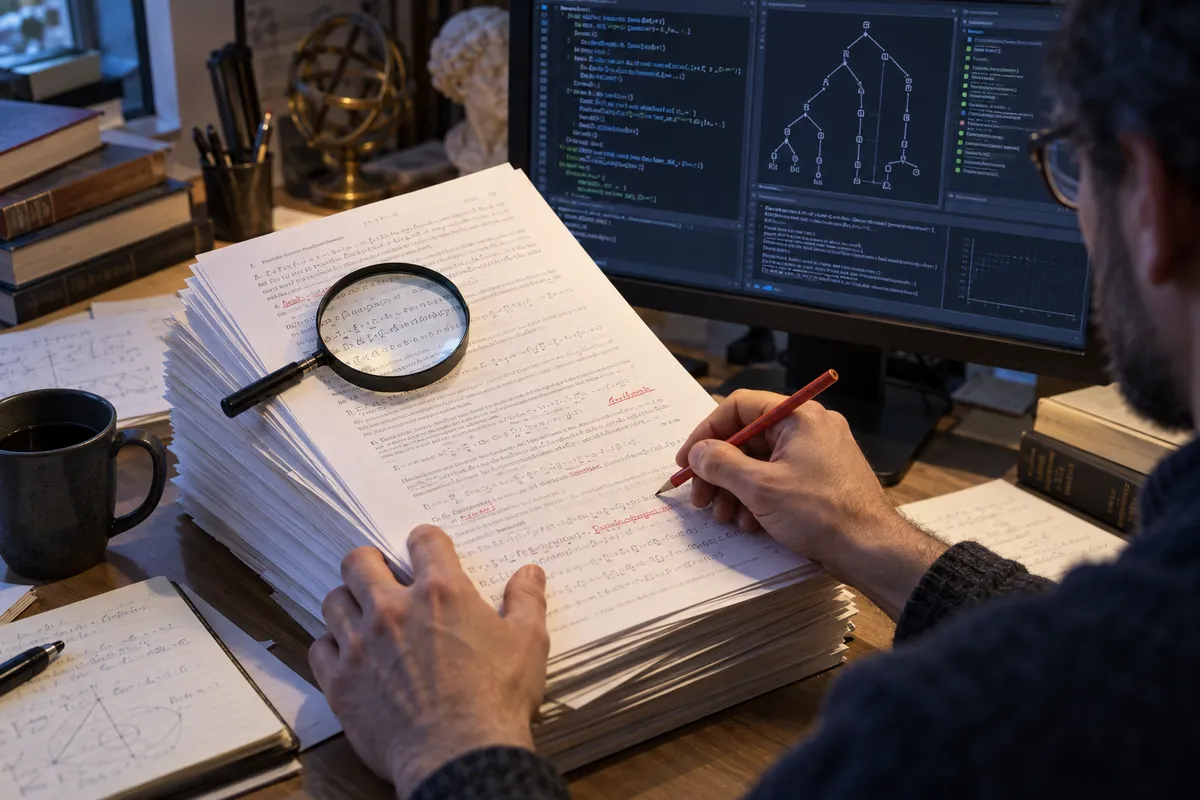
An Anthropic employee and mathematician says he used a non-public version of Claude to produce a 250,000-line proof of the Riemann hypothesis, one of mathematics' most famous unsolved problems. That's the claim, as reported by the BBC. It has not been verified, and verification will take time.
This is a maths story, but it matters to anyone who follows medical research, because health news is now full of AI announcements too: drug discovery, diagnostics, clinical tools. The Riemann claim is a clean case study in how to hold a big announcement at arm's length until it earns your trust. By the end, you'll have a practical checklist you can use on the next "AI breakthrough" headline, medical or otherwise.
What has actually been claimed
Per the BBC's report, the mathematician says the proof was written in Lean, a language designed so that a computer can check each logical step. The proof runs to roughly 250,000 lines. The report describes the claim as potentially historic but unconfirmed.
That is the extent of what the reporting supports. There's no independent confirmation yet, and the claim comes from someone who works at the company whose model is said to have produced it.
Why a Lean proof is interesting, and still not the end of the story
A proof written in Lean is a different kind of object from a typical maths paper. Instead of a human reader judging whether an argument feels airtight, software checks every step against formal rules. In principle, that makes verification more mechanical.
But 250,000 lines is enormous, and the verification will take time, per the BBC. Reviewers will want to confirm several things:
- The code compiles and checks without gaps or workarounds.
- The statement that was proven is actually the Riemann hypothesis, not a subtly different claim.
- The definitions the proof rests on mean what mathematicians think they mean.
Those are my framing of what careful review would involve, not details from the report. But they illustrate the point: a checkmark from a machine is only as good as the question you asked it.
Why the timing invites scrutiny
The BBC notes the claim lands just after Anthropic's stock market debut, and during a wave of AI labs publicising major scientific and mathematical results. Nothing in the reporting suggests the claim is a marketing move, and it would be unfair to assume so. But it's reasonable to observe that when a company has commercial incentives, outside confirmation matters more, not less.
The broader debate, per the BBC, is whether AI is accelerating discovery or turning science into a credibility and marketing battleground. Both can be true at once.
A five-question checklist for any AI breakthrough claim
Here's how to apply the same caution to health headlines.
1. Who is making the claim, and who benefits?
An employee announcing a result from an unreleased model is a starting point, not a conclusion. In medicine, the equivalent is a company-run study of its own tool.
2. Can independent experts check it?
In maths, the proof can be examined line by line. In health, look for peer review, public data, and replication by groups with no stake in the outcome.
3. Is the tool available?
The model here is non-public, per the BBC, which limits outside testing. A clinical AI that only its developer can run is hard to evaluate.
4. What exactly was shown?
"Proved the hypothesis" and "produced something that looks like a proof" are different statements. Likewise, "detects disease" and "detected disease in a curated test set" are not the same thing. Read for the narrow claim.
5. What do cautious experts say?
Mathematicians are urging caution on this one, according to the BBC's framing. When specialists in the field hold back, take the hint and wait.
What it could mean if it holds up
If the proof is confirmed, it would be a landmark: an AI-assisted result on a problem that has resisted mathematicians for a very long time. It would also raise a practical question for researchers in every field, including medicine: how do humans verify work too large for any one person to read? Formal, machine-checkable proofs may become part of the answer in maths. Health research will need its own equivalents, such as open data, preregistered trials, and independent replication.
If it doesn't hold up, that's useful too. It would be a reminder that impressive output and correct output are different things.
The takeaway
When a bold AI claim arrives, whether it's about prime numbers or cancer screening, don't rush to believe it or dismiss it. Hold it as "unverified" until independent experts have looked, and make the claimant's evidence, not the headline, do the persuading.